The office
The best AI use case is rarely the most impressive demo.
It is the workflow with a valuable outcome, usable data, appropriate oversight, manageable risk, and a team ready to adopt it. Finding that one is the work.
Buy the tool before you have found the use case and you own a license, not an outcome.
See the questions
The workflows worth automating first.
Areas of the business
Before long, you are reacting more than growing.
Hiring, marketing, sales, operations and clients all land on the same few people. That is where AI has become an advantage for us: we use it ourselves for brainstorming, content, workflow and even hiring support.
The questions you're already asking.
Every one of them has a vendor waiting to answer it for you.
01Use case
Which process should be automated first?
02Data
What information does the process depend on?
03Approach
Should the capability be bought or built?
04Oversight
What level of human oversight does the work require?
05Ownership
Who owns the process once it is in production?
06Systems
Which of the systems you already run can an AI read from, and which should it never change?
If you can't answer these yet, that's normal. Answering them is the job.
Book a free 30-minute callGo deeper
- Is AI worth it for my business?
- Is my business ready for it?
- Is my data good enough?
- What does AI really cost?
- Build it, buy it or subscribe?
- How do I choose a tool?
- Is my data safe with a vendor?
- Who runs it in-house?
- Why do AI pilots stall?
- How do I know it worked?
- When should we not use AI?
- What about the shop floor?
- AI in your business systems
- Quoting and estimating
- Orders, invoices and paperwork
- Engineering data and work instructions
- Inventory, purchasing and shipping
- Scheduling and dispatch
- Quality and inspection data
- Metrology
- Maintenance and work orders
- Customer service and communication
- Knowledge at the machine
- AI receptionists and phone agents
- AI assistants for the whole team
- AI meeting notes and call summaries
- A chat assistant on your website
- Missed-call text back
- Booking by text and chat
- Review requests and replies
- Lead follow-up that keeps going
- Invoice and payment chasing
- Ask your own documents
- Intake that fills your system
- Marketing drafts in your voice
AI for Small Business
Engage us at any point on that path. Start where you are already stuck.
AI Opportunity Assessment
Inventory where AI could create value across the business, then rank by outcome, feasibility, and risk rather than novelty.
Workflow and Process AI
Map the workflow as it really runs, and find the steps where automation or assistance genuinely removes friction.
AI Tool and Vendor Evaluation
Compare buy, configure, integrate, and build, and evaluate platforms on security, portability, and total cost, not the demo.
Data Readiness and Governance Planning
Establish what data, permissions, security, and oversight a use case requires before it touches anything that matters.
Responsible AI Roadmap and Adoption Support
Sequence a pilot, define the human review points, and prepare the team so adoption starts small, measured, and reversible.
AI in the Systems You Already Run
Map how quoting, scheduling, intake, invoicing and inspection data move through your ERP, MES and quality systems, and find where an AI layer would pay. Read-only first, before anything is bought.
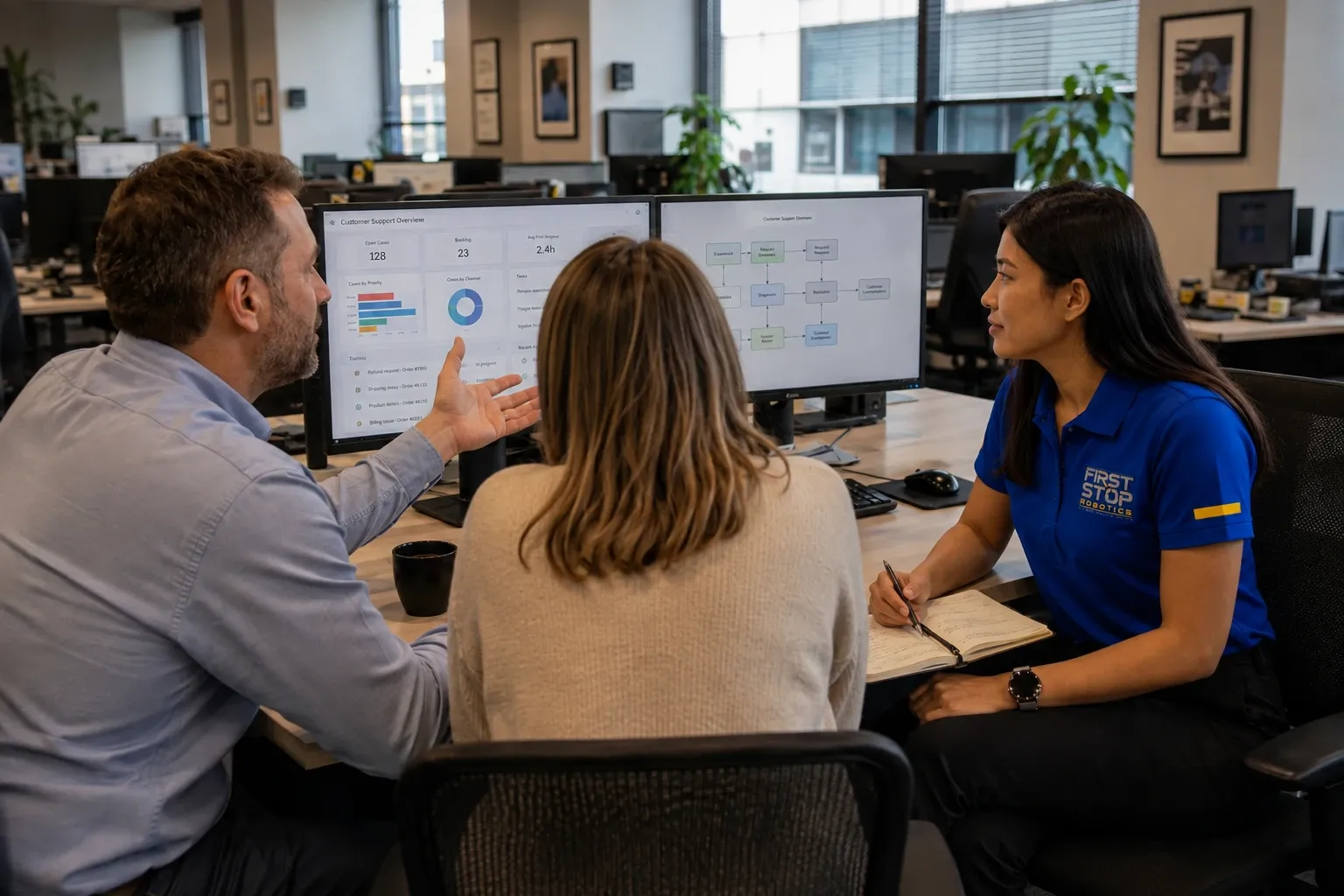
Buy, configure, or build, settled before you spend.
What you leave with.
- AI opportunity inventory
- Use-case value and feasibility matrix
- Workflow and data-readiness assessment
- Tool/vendor comparison framework
- Governance and human-oversight requirements
- Pilot recommendation
- Responsible AI adoption roadmap
- Business-systems readiness read: what an AI can read from today, and what it should never write to
- Executive recommendation brief
What industry are you in?
Any operation with a back office runs on workflows, and on the systems that carry them: orders, invoices, scheduling, quality, support. If yours eat hours every week, we score them.
The other rooms
AI Learning
Not ready to decide? Fifty-six lessons in plain English first: what a language model is, what an agent is, where it gets things wrong, and the words vendors use.
SaaS for Manufacturing and Business
Most of what an AI reads and drafts lives in the ERP, the MES and the quality system. Picking those, rescuing a rollout, or getting more from the one you run is its own room.
Robotics & Automation
A free reference on the cell, the line and the throughput the office plans around. We no longer take on robotics projects.
Start with the problem.
Thirty minutes on your business and where AI fits it, from the front desk to the floor. We'll break down your process, pain points, and bottlenecks, then point you in the right direction. Vendor-agnostic, no strings attached.